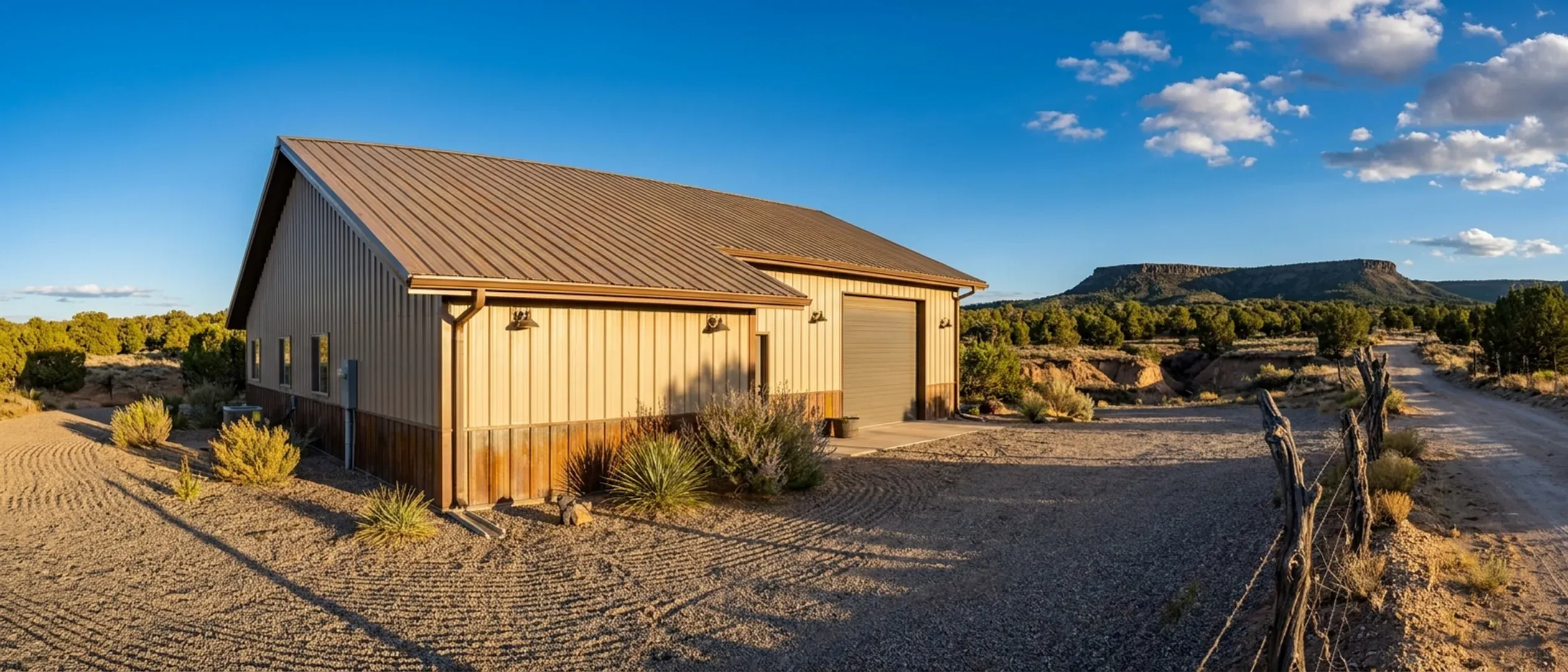
Are Barndominiums Worth It in New Mexico? Land, Water, Appraisal and the Shop-Plus-House Case
A barndominium is worth building when the thing it does best, one large, adaptable building with a real shop under the same roof, is something you need, on land that can support a house, for long enough to earn back the choices you make. In New Mexico the land question is sharper than in most states. Water on an unserved parcel comes from a domestic well permitted by the State Engineer, whose rule sets a limit on how much a household well may draw. Septic comes from a state permit whose lot-size table can rule a small parcel out of a conventional system. Then there are the questions every barndominium owner faces: how an appraiser will value a building type with few comparable sales, how an insurer will classify it, and what records a future buyer will want. This guide works through each, using New Mexico's rules and agencies as the reference points, and ends with the questions that settle it for a particular parcel.
Figures on this page are cited third-party or government data, not a quote from New Mexico Barndominium Builders.
Bottom Line Up Front
- Worth it usually means: you need the shop or the open span, you own or are buying land with a clear answer on water and septic, and you plan to stay long enough that resale to a narrower market is not the main concern.
- Water and septic can decide the answer before the building does. Under 19.27.5 NMAC a single-household domestic well is generally limited to 1.0 acre-foot a year, and under 20.7.3.301 NMAC a conventional septic system needs a lot of at least 0.75 acre.
- The paperwork protects the value. The Construction Industries Division warns that insurance may be denied without proof of permits, inspections or a certificate of occupancy, and a lender's appraiser will look for the same file.
Where the answer is clearly yes
The strongest cases have several of these at once.
You need a real shop, and would build one anyway
If a separate garage, barn or workshop is part of the plan regardless, putting it under the same roof as the house can use one foundation, one roof and one set of site work. The value comes from the shop you would otherwise build separately.
You own or are buying land with a clear answer on water and septic
A parcel with water service, or a permitted domestic well, and enough area for the septic system your bedroom count needs takes the biggest uncertainties off the table.
You want an open, adaptable plan
Clear spans let the interior be rearranged later without disturbing the structure, which suits owners whose needs will change.
You intend to stay
Time in the house lets you enjoy what the building does well and makes the narrower resale market matter less.
Where the answer is probably no
None of these rule a barndominium out, but each weakens the case.
You expect to sell within a few years
Few comparable sales and a narrower pool of buyers make a quick resale harder than with a conventional house.
You need the largest possible loan
If the appraisal leans on conventional houses and discounts the shop, the loan may be smaller than the build cost.
The lot is small or in a subdivision
Below 0.75 acre, a conventional septic system is off the table under 20.7.3.301 NMAC. Subdivision covenants may restrict metal buildings or large accessory structures; read them before buying.
Water is uncertain
If a domestic well is doubtful, restricted, or would not meet your needs within the State Engineer's limits, settle that before anything else.
Questions that decide it for your land
Each can be answered before you buy or commit to a plan.
Does the zoning allow a dwelling, and a building this size?
The county or city planning and zoning office decides, and CID expects its approval before a building permit.
Will the lot take a septic system?
Compare the lot size with the table in 20.7.3.301 NMAC for your bedroom count, and ask the Environment Department for a letter of determination on whether stricter requirements may apply. It answers within 10 working days and the letter is valid for a year.
Where will the water come from?
A water system, an existing permitted well, or a new domestic well permit from the State Engineer, subject to any court or local restrictions.
Is the parcel in a wildfire-risk community?
The Forestry Division's Communities at Risk map and the county's wildfire protection plan show it, and an insurer will likely ask.
What will the lender and insurer say?
Ask both before you commit, with a description of the structure and the shop use.
How long will you stay?
The longer the answer, the stronger the case.
What a barndominium does not change
Some costs and obligations are the same whatever the structural system.
Site work, septic and water
The pad, driveway, septic system and well cost the same for a barndominium as for any house on the same land.
Interior finishes and mechanical systems
Kitchens, bathrooms, flooring, heating, cooling and electrical work are priced like any house's. Separate permits for building, electrical, mechanical and plumbing work apply under 14.5.2 NMAC.
The energy code
The 2021 New Mexico Residential Energy Conservation Code applies to a barndominium like any house, at the climate zone for its location.
Reading this because you are weighing a build? The next step is a plan drawn for your program.
What's different about New Mexico
Water is often the real value of rural land
Where there is no water system, a house depends on a domestic well permitted by the Office of the State Engineer under Section 72-12-1.1 NMSA. The rule, 19.27.5 NMAC, generally limits a well serving one household to 1.0 acre-foot a year, allows up to 3.0 only where the applicant shows the combined diversion will not impair existing rights, and lets a court or a lawful city or county ordinance impose tighter limits. The State Engineer may reject a new domestic well where a court has restricted new wells or in an area of water-quality concern. For a barndominium owner who plans livestock, a large garden or a shop that uses water, those limits are part of whether the land is worth buying.
The septic table can rule a small lot out
The Environment Department's liquid waste rule, 20.7.3 NMAC, bases the septic design flow on bedrooms and sets minimum lot sizes for conventional systems: 0.75 acre up to 375 gallons a day, which covers three bedrooms, 0.88 acre at 440 gallons for four bedrooms, and one acre at 500 gallons for five. A smaller lot, or more bedrooms than the lot supports, means a system that reduces nitrogen. Check the lot against the table before you pay for the land.
Appraisal is where the value question gets tested
A construction or permanent loan depends on an appraiser finding comparable sales. Where few post-frame or steel homes have sold nearby, the appraiser may lean on conventional houses and adjust, and a large shop may add less to the appraised value than it cost to build. That does not make the building a poor choice, but it can mean a larger down payment than you expected. Bring plans, specifications and any local barndominium sales you know of to the lender early.
Permits and inspections are part of what you are buying
The Construction Industries Division's FAQ says insurance may be denied if no proof of permitting, inspections or a certificate of occupancy can be provided, and answers the question of why you need a permit for your own house with the need to keep a record of inspection for future reference. For a building type some underwriters and appraisers already scrutinise, a complete permit and inspection file is part of the house's value.
Building it yourself is for living in, not for selling
New Mexico's homeowner's permit under 14.5.2.18 NMAC lets you build your own primary residence without a contractor's licence, provided you perform the major portion of the work by dollar value. It is limited to a residence you occupy or intend to occupy, and each permit covers work at the primary residence only, not rental property or any commercial work or property, which matters if the shop is for a business; a homeowner-permit project may not be placed on the market for sale while under construction, which voids the permit automatically; and no more than one homeowner's permit for a single-family dwelling will be issued to the same owner in any 12-month period. The inspections rule, 14.5.3 NMAC, also requires the certificate of occupancy for such a house to state that it was built under a homeowner permit, so a future buyer and their lender will see it. If the plan is to build and sell, this route does not fit.
The energy code protects comfort and resale
The 2021 New Mexico Residential Energy Conservation Code, 14.7.6 NMAC, applies to residential work within CID's jurisdiction and assigns a climate zone by location, from 3B in Las Cruces, Carlsbad and Roswell to 7B in Red River and Angel Fire. A metal-skinned building built to its zone is more comfortable and cheaper to run, and it is easier to defend to a buyer or an appraiser than one built to a lower standard.
Pros and cons, honestly
Pros
- One building can serve as home and genuine workshop, sharing a foundation, roof and site work.
- Clear spans make the plan adaptable over decades.
- Metal roofing and siding are durable and not combustible.
- The shell goes up quickly once the approvals are in place.
- Owners building their own primary residence can use New Mexico's homeowner's permit rather than hiring a licensed general contractor.
- Nothing in the state residential code treats a post-frame or steel home differently from any other house.
Cons
- Appraisals may lean on conventional houses and discount a large shop.
- Resale is to a narrower pool of buyers.
- Water limits and septic lot-size rules can make a parcel unsuitable regardless of the building type.
- Some insurers classify the structure differently and scrutinise a shop under the same roof.
- The homeowner's permit does not allow building to sell: a house built under it may not be marketed while under construction.
- The envelope must be carefully designed for the climate zone, from desert heat to mountain cold.
Are barndominiums worth it in New Mexico?
Do barndominiums hold their value in New Mexico?
How much land do I need?
Can I get water for a barndominium on rural land?
Will a bank lend on a barndominium in New Mexico?
Can I build it myself and sell it?
Will a barndominium be hard to insure?
Who should not build a barndominium?
Questions answered? Tell us what you want to build and we will put real numbers against it.
Sources
- 19.27.5 NMAC — Domestic well permits under Section 72-12-1.1 NMSA (State Engineer)
- 20.7.3 NMAC — Liquid waste disposal and treatment (lot size, design flow, letter of determination)
- 14.5.2 NMAC — Permits (homeowner's permit, 14.5.2.18)
- 14.5.3 NMAC — Inspections (certificate of occupancy for homeowner-permit residences)
- 14.7.6 NMAC — 2021 New Mexico Residential Energy Conservation Code
- Construction Industries Division — Frequently Asked Questions
- EMNRD Forestry Division — Community Wildfire Protection Plans and Communities at Risk
Keep reading
The pages that answer the next question this one raises.
Barndominium pros and cons in New Mexico
Wind, monsoon, elevation, wildfire and the envelope, weighed in detail.
Read itAre barndominiums legal in New Mexico?
Codes, permits, septic, wells and zoning.
Read itBarndominium financing
Construction loans, appraisal and what lenders ask for.
Read itShouses
Shop-plus-house designs, where the barndominium case is strongest.
Read itBarndominium cost in New Mexico
What drives the budget, with every figure attributed.
Read itTell us about your land
Start the survey and we will look at your parcel, water and plans with you.
Read itWant a real number instead of a range?
Start the survey and tell us about your land and what you want to build. Include the county and parcel ID if you have them, because in New Mexico the jurisdiction, the water supply, the well and the septic answers change the budget more than the building does. The survey costs nothing.