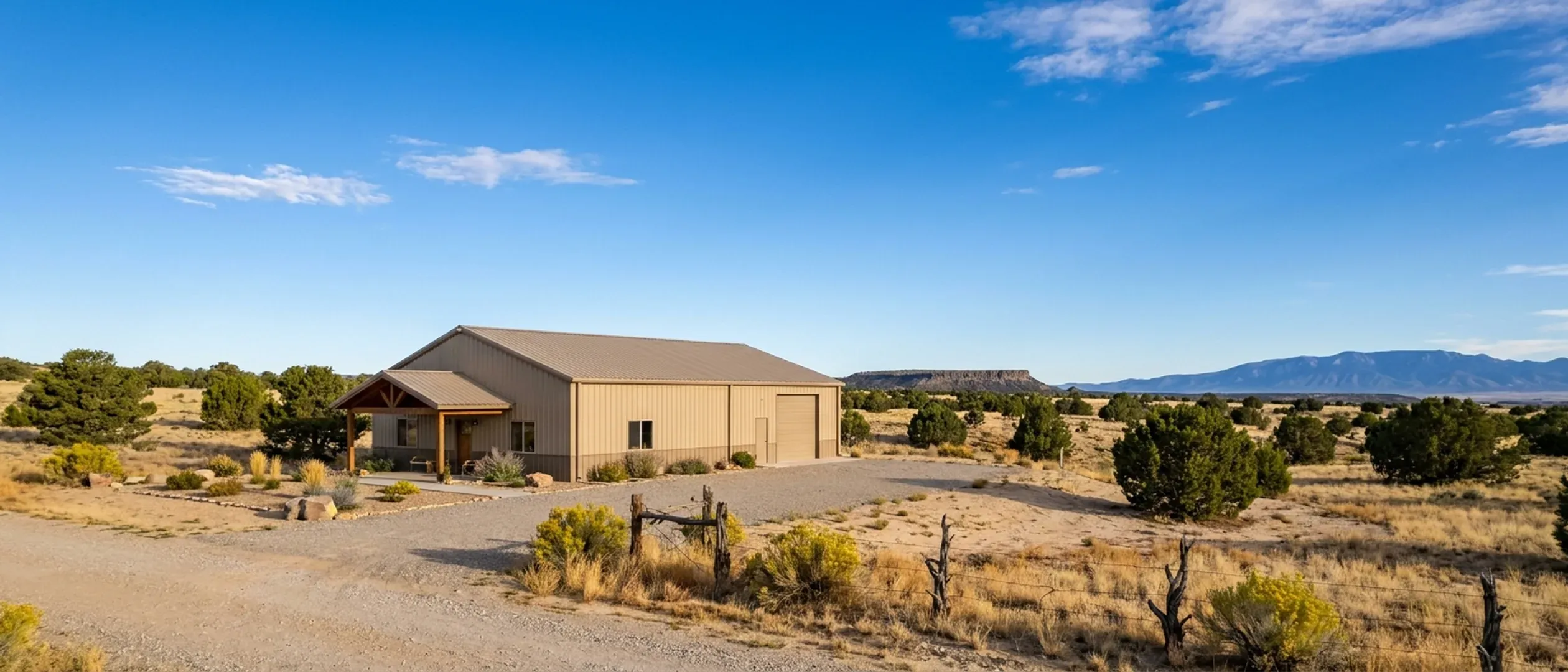
Barndominium Financing in New Mexico: Construction Loans, USDA and Housing New Mexico
A barndominium is financed like any custom home built on your own land: a construction loan that pays the builder in stages, then a permanent mortgage, sometimes rolled into one. What makes it harder is the appraisal, because lenders lend against value and a steel or post-frame home may have few comparable sales nearby. This guide sets out the options that exist in New Mexico, from USDA Rural Development to Farm Credit lenders and Housing New Mexico's first-time buyer programs, each from the program's own published terms. It is not lending advice; a lender decides what you qualify for.
Figures on this page are cited third-party or government data, not a quote from New Mexico Barndominium Builders.
Bottom Line Up Front
- In the Census Bureau's 2025 data for the West, 65% of contractor-built homes on the owner's land were financed conventionally and 32% paid for in cash. FHA and VA loans were rare.
- USDA Rural Development's guaranteed loan can finance building a home in an eligible rural area with 100% financing, including as a single-close construction-to-permanent loan through participating lenders. The site must not be used principally for income-producing purposes.
- The appraisal is the step to plan for. Fannie Mae's Selling Guide accepts unique homes case by case, and large barns or farm-type outbuildings can make a lender ask whether the property is residential at all.
What actually moves the number
One closing or two
A two-close build uses a construction loan, then a separate mortgage with its own closing costs. A single-close construction-to-permanent loan converts at completion. USDA and some Farm Credit lenders publish single-close options.
The appraisal sets the ceiling
Lenders lend against appraised value, not cost. If comparable sales cannot support the value, the difference comes from the borrower's cash.
Rural eligibility is by address
USDA Rural Development loans are made only in areas it designates as rural. Its eligibility site checks a specific address, so check the parcel before planning around a USDA loan.
The shop can complicate it
USDA's rules exclude sites with land or buildings used principally for income, and its direct loan rule excludes farm service buildings. Housing New Mexico's FirstHome restricts business use. Plan a shop's use with the lender early.
How custom homes in the West are actually paid for
The Census Bureau tracks how contractor-built homes on the owner's land are financed. Its 2025 figures for the West region set the baseline.
Mostly conventional loans
65% of contractor-built homes started in the West in 2025 were financed with conventional loans, which includes loans no government agency insures.
Almost a third paid cash
32% were paid for in cash. Many owners building on their own land sell a previous home or draw on savings rather than borrow the whole cost.
FHA and VA were rare
About 1% used FHA-insured loans and 2% VA-guaranteed loans in the Census West figures for 2025.
What the loans had to cover
The Census median contract price for those West homes was $377,200 in 2025, excluding the lot. Land, well and septic come on top unless they are already paid for.
USDA Rural Development
USDA runs two Section 502 home loan programs, both limited to areas it designates as rural and both for a primary residence.
Guaranteed loans can build with 100% financing
USDA's guaranteed loan page says eligible applicants may purchase, build, rehabilitate, improve or relocate a dwelling in an eligible rural area with 100% financing, with household income no more than 115% of the area median. It lists site preparation, including grading and driveways, as an eligible use and says there are no set acreage limits.
Single close through participating lenders
7 CFR 3555.101 lets USDA guarantee a combination construction and permanent loan, and USDA publishes a list of lenders participating in its single-close construction-to-permanent program. The loan is applied for through an approved lender, not through USDA.
Direct loans for lower incomes
USDA's New Mexico direct loan page says funds can be used to build a home or to purchase and prepare sites, including water and sewage facilities. From 1 September 2026 USDA lists the direct loan rate at 5.250%, with payment assistance that can lower it to as little as 1% and terms up to 33 years.
Site rules that affect a barndominium
7 CFR 3555.201 requires a site typical in size for the area and excludes land or buildings used principally for income-producing purposes. 7 CFR 3550.56 says a direct-loan site must not be large enough to subdivide and must not include farm service buildings, though a small storage shed may be included.
Farm Credit and rural lenders
Farm Credit associations lend on rural homes and land as well as farms. Farm Credit's own directory lists AgTrust Farm Credit and American AgCredit among the institutions serving New Mexico.
Construction that converts without a second closing
AgTrust Farm Credit publishes construction loans for rural New Mexico borrowers with 12 months to complete the build, interest only on the money used, and automatic conversion to a regular loan so closing costs are not paid twice.
Home, lot and construction loans
American AgCredit's New Mexico page lists rural homes and acreages, home lot loans and home construction loans alongside its farm and ranch lending.
Land first, then the house
Many owners buy land with a land loan or cash, then use its equity toward the construction loan. Ask each lender whether land you own counts toward the down payment and how it is valued.
Local banks and credit unions
Banks and credit unions that hold construction loans in their own portfolio can be more flexible about unusual homes than lenders who must sell every loan. Ask directly whether they have financed barndominiums or post-frame homes.
The appraisal: the step to plan for
Most lenders follow Fannie Mae's appraisal standards even when they keep the loan. Its Selling Guide covers the situations a barndominium raises.
Unique homes are eligible, case by case
Fannie Mae says loans on unique or nontraditional housing are eligible provided the appraiser has adequate information to develop a reliable opinion of market value, decided case by case by both the appraiser and the underwriter.
Comparable sales do not have to match
It is not necessary for comparable sales to be of the same design. Where recent similar sales are missing, the appraiser may show market acceptance with older sales, sales in competing neighbourhoods and similar properties in the area.
Large outbuildings raise a question
Fannie Mae treats large barns, silos, storage areas and facilities for farm-type animals as significant outbuildings that may indicate an agricultural property. The lender must decide whether the property is residential in nature.
Give the appraiser what they need
Plans, a finish specification and any local barndominium sales you know of help the appraiser support value. Steel-framed homes are uncommon: the Census Bureau counted 1% of 2025 West contractor-built homes with steel framing.
Reading this because you are weighing a build? The next step is a plan drawn for your program.
What's different about New Mexico
Housing New Mexico's programs are written for buying
Housing New Mexico, the trade name of the New Mexico Mortgage Finance Authority, offers FirstHome for first-time buyers with low to moderate incomes, a 620 minimum credit score and required homebuyer counseling. Its fact sheets describe purchasing a home, so ask a participating lender whether a program can serve as the permanent loan on a home built on your own land.
The new-home rate buydown has conditions a custom build may not meet
Housing New Mexico's NewHome Rate Advantage gives a permanent 1.00% rate buydown on a HomeForward mortgage for purchasing a newly constructed, site-built home whose certificate of occupancy is no more than twelve months old. It excludes manufactured and modular homes, second homes and rentals.
Lenders will see the contractor's licence number
NMSA 60-13-19(A) requires a licensed contractor to show the licence number on all written bids and when applying for a building permit. A construction lender reviewing bids can check the number with the Construction Industries Division.
A licence and bond do not guarantee completion
Under NMSA 60-13-19(C), before residential work starts, a contract is signed or funds are paid, the contractor must disclose in writing that the licence and bond do not protect the consumer if the contractor defaults. That is why construction lenders pay in inspected draws rather than up front.
Can you get a mortgage for a barndominium in New Mexico?
Can a USDA loan be used to build a barndominium?
Is my land eligible for USDA financing?
Does Housing New Mexico finance new construction?
What credit score do I need?
Will a big shop affect my loan?
Can I be my own builder and still get a loan?
How do construction draws work?
Questions answered? Tell us what you want to build and we will put real numbers against it.
Sources
- USDA Rural Development — Single Family Housing Direct Home Loans in New Mexico — Read 26 Sep 2026; rate effective 1 Sep 2026
- USDA Rural Development — Single Family Housing Guaranteed Loan Program
- 7 CFR 3555.101 — Loan purposes (USDA guaranteed loans)
- 7 CFR 3555.201 — Site requirements (USDA guaranteed loans)
- 7 CFR 3550.56 — Site requirements (USDA direct loans)
- Housing New Mexico — Mortgage Programs
- Housing New Mexico — FirstHome fact sheet (PDF, rev. 10/22/25)
- Housing New Mexico — NewHome Rate Advantage fact sheet (PDF, rev. 07/14/26)
- Farm Credit — New Mexico
- AgTrust Farm Credit — Construction Loans: Build Your Rural Dream with Confidence
- American AgCredit — New Mexico
- Fannie Mae Selling Guide B4-1.3-05, Improvements Section of the Appraisal Report
- U.S. Census Bureau — Contract Price of New Contractor-Built Houses Started, by Region and Type of Financing — West 2025: 65% conventional, 1% FHA, 2% VA, 32% cash; median $377,200
- U.S. Census Bureau — Type of Framing in New Single-Family Houses Completed
- 14.5.2 NMAC — Permits (homeowner's permit, 14.5.2.18)
- NMSA 1978 Chapter 60 (Construction Industries Licensing Act, § 60-13-19), NMOneSource (PDF)
Keep reading
The pages that answer the next question this one raises.
Barndominium cost in New Mexico
The published figures a lender's budget review will be compared against.
Read itHow big a barndominium your budget builds
Turning an approved loan amount into a realistic floor area.
Read itAre barndominiums legal in New Mexico?
Permits, the homeowner's permit and the contractor licensing rules lenders check.
Read itBarndominium build timeline in New Mexico
How long each stage takes, which sets how long a construction loan must run.
Read itWant a real number instead of a range?
Start the survey and tell us about your land and what you want to build. Include the county and parcel ID if you have them, because in New Mexico the jurisdiction, the water supply, the well and the septic answers change the budget more than the building does. The survey costs nothing.