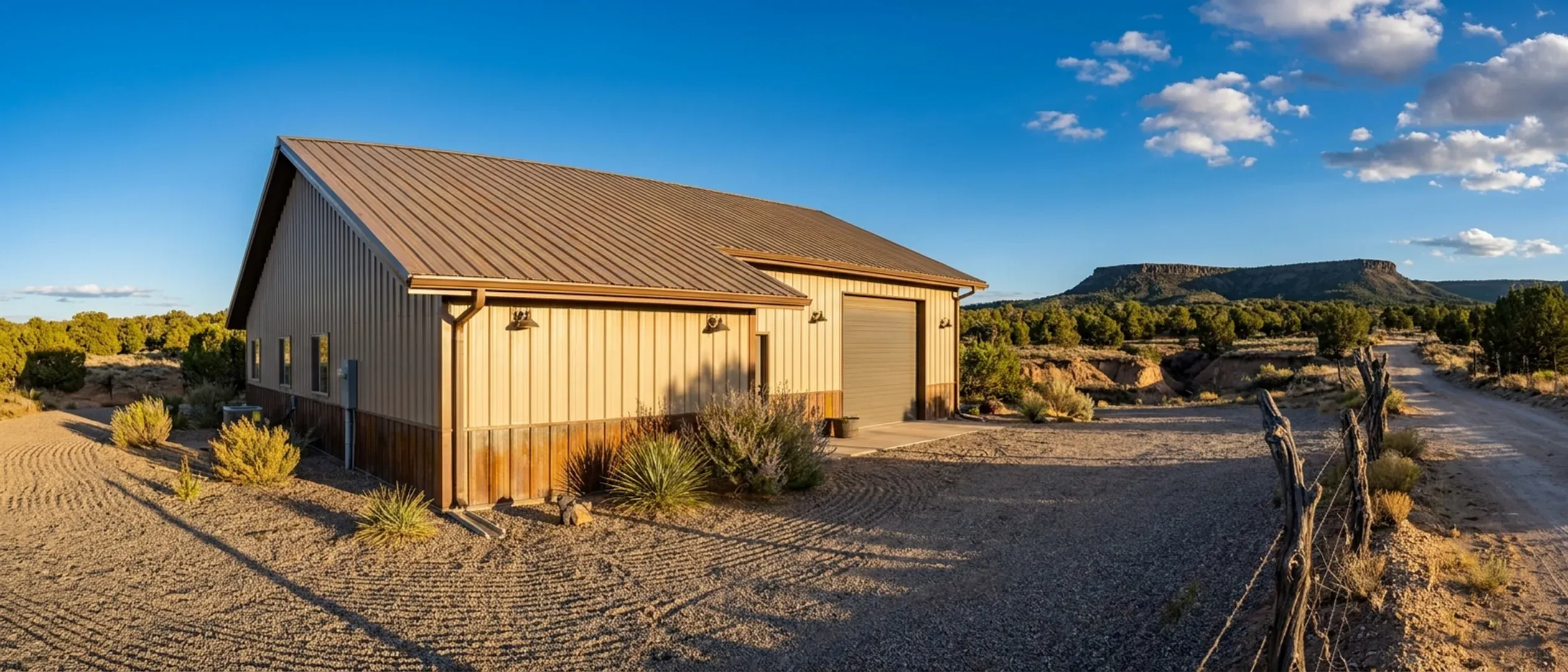
Barndominium Build Timeline in New Mexico: Septic, Wells, Permits and the Monsoon
The frame of a post-frame or steel barndominium goes up quickly. What decides whether a New Mexico project takes one season or two is everything around the frame: whether a dwelling is allowed on the parcel, whether the soil and lot size will take a septic system, whether you can get water, and when in the year the concrete and the shell land. New Mexico is unusual in that several of these steps are run by state agencies with published clocks. The Environment Department issues the septic permit everywhere except unincorporated Bernalillo County, which has its own ordinance, and state rule forbids building the house before it does. The Office of the State Engineer permits the domestic well. The Construction Industries Division issues the building permit wherever a city or county does not run its own full-service building department, and its rules put an expiry date on every permit. Then the weather adds two seasons worth planning around: spring, when the National Weather Service says New Mexico is windiest, and the summer monsoon, from June 15 to September 30. This guide sets out the order the state makes you work in and the timings its own rules and agencies publish.
Figures on this page are cited third-party or government data, not a quote from New Mexico Barndominium Builders.
Bottom Line Up Front
- The septic permit comes first. Under 20.7.3.401 NMAC no one may build a house on a lot that needs an on-site system until the Environment Department has issued the liquid waste permit, and the rule gives the Department 10 working days from a complete application for a conventional system, or 20 where stricter requirements may apply.
- Zoning approval comes before the building permit. The Construction Industries Division lists a missing zoning approval as the first thing that slows a permit, and its FAQ says residential permits are being processed in 3 to 4 working days once a complete package is in.
- Every New Mexico building permit has a clock: under 14.5.2.14 NMAC it expires if work does not start within 180 days, and it is cancelled if work stops for more than 180 days. A domestic well permit expires if the well is not completed and its record filed within one year.
Published New Mexico review clocks
These are the timings the state's own rules and agencies publish. None of them includes the time it takes you to assemble a complete application, and none applies to a city or county building department that sets its own.
Septic permit, conventional system: 10 working days
From a complete application, under 20.7.3.402 NMAC. Completeness is decided within five working days. The Environment Department may extend to 20 working days where stricter requirements may apply, and must say so within the first 10.
Letter of determination on a lot: 10 working days
Before you buy, 20.7.3.201 NMAC lets you ask the Environment Department in writing whether stricter liquid waste requirements may be imposed on a lot. The Department issues the letter within 10 working days and it is valid for one year. It does not guarantee a permit, but it tells you early whether the simplest kind of system is even in play.
CID residential building permit: 3 to 4 working days
The processing time the Construction Industries Division states in its FAQ for residential permits, handled in the order received. For a homeowner's permit the FAQ says CID will issue the permit within five working days of a complete package, which must already include the county's zoning approval.
Building permit life: 180 days to start, 180 days of inactivity
Under 14.5.2.14 NMAC a permit expires if work does not begin within 180 days of issue, and is cancelled if work is suspended or abandoned for more than 180 days, after which a new application and a new, full permit fee are required. The building official may extend an active permit by up to 180 days on a written request showing delays beyond the permit holder's control.
Domestic well permit life: one year
Under 19.27.5 NMAC the permit expires automatically unless the well is completed and the well record filed with the State Engineer within one year of issue, and the rule allows no extension.
The stages, in the order New Mexico makes you do them
A barndominium on raw land usually moves through these stages. Several can overlap, but the rules fix the order of a few of them.
1. Parcel due diligence
Confirm the parcel is a legal lot, that a dwelling is allowed there, and who issues building permits for it. Find out whether water is available from a system or must come from a well, and whether the lot is large enough for a conventional septic system. Land within tribal or federal boundaries follows different rules entirely, so confirm jurisdiction before anything else.
2. Zoning approval
The Construction Industries Division expects the county or city planning and zoning approval before it accepts a building permit, and 14.5.2.18 NMAC lists it, with a flood plain determination, among the documents a homeowner's permit application must include. Setbacks and any limits on accessory buildings are decided here.
3. Soils and the septic permit
Test holes or soil borings as the Environment Department requires, a system design sized on bedrooms, and the permit application to the Department's field office for the area, or in unincorporated Bernalillo County to the county under its own ordinance. The design flow in 20.7.3.201 NMAC rises with each bedroom, so settle the bedroom count before this step, not after.
4. The well permit and drilling
Where there is no water service, the State Engineer's permit, then the driller. The one-year expiry means this step should not run far ahead of the build.
5. Plans and the building package
The kit or building package, the structural design for the frame, and plans complete enough for review. Under 14.5.2 NMAC separate permits are required for general building, electrical, mechanical and plumbing, and LP gas work. CID's FAQ tells applicants to count all covered or roof space when stating square footage, so a shop bay and covered porches count. Where CID issues the permit, its residential permit guide calls for plans sealed by a New Mexico registered architect or structural engineer for red-iron steel and for prefabricated or premanufactured structures, so allow time for that seal.
6. Site work and foundation
Pad, drainage, septic placement and the slab. Time this outside the monsoon where you can, and away from frozen ground at elevation.
7. Shell erection and dry-in
Frame, roof and wall panels, doors and windows. This is the fast part of a barndominium, and the part most exposed to spring wind and summer downbursts.
8. Rough-ins and inspections
Electrical, plumbing and mechanical rough-ins, each under its own permit and inspection. The septic system is inspected by the Environment Department at the stage the permit names, and every homeowner-installed system is inspected.
9. Insulation, finishes and final inspections
Insulation to the energy code for your climate zone, drywall and finishes, then final inspections and, where issued, the certificate of occupancy. Keep every permit and inspection record; lenders and insurers ask for them.
Planning around a New Mexico year
Seasons differ sharply between the southern deserts and the northern mountains, so treat these as patterns to adapt to your elevation.
Late winter and early spring: approvals and ground work in the south
A good time to have zoning, septic and well approvals moving, and in the low desert to pour the slab before the heat and the monsoon.
April and May: the wind season
The National Weather Service's windiest months. Plan for lost erection days when the shell goes up in this window.
June to September: the monsoon
Afternoon thunderstorms, downbursts and flash floods, most of all in July and August. Aim to have the building dried in before the heaviest storms, and keep trenches and open excavations short-lived.
Autumn: the second window
After September 30 the monsoon season ends, and many sites get a settled stretch before winter. At elevation it is the last chance to close in the shell before snow.
Winter: interiors, and at elevation little else
In the northern mountains snow and frozen ground can stop site work, so a dried-in building lets the interior trades keep going. In the southern low desert, winter can be a productive season for outdoor work.
What most often stretches a New Mexico schedule
None of these depend on the building being a barndominium. All of them show up in the state's own rules and guidance.
Applying for the building permit before zoning approval
CID names it first among the causes of slow permits. Get the zoning approval letter in hand first.
An incomplete application
Both the septic and building permit clocks start only when the application is complete. Plans must be drawn to scale, and CID lists not enough information for review as a cause of delay.
Stricter septic requirements on the lot
A shallow aquifer, fractured bedrock or a nearby contamination plume can lead the Environment Department to require more than a conventional system, with a longer review. A lot below 0.75 acre cannot take a conventional system under 20.7.3.301 NMAC unless the nitrogen load is reduced. The letter of determination is the early warning.
Water
Drilling schedules, restrictions on new wells in some areas, and the one-year permit life. Settle water before you buy.
Owner-builder exams
A homeowner's electrical permit requires passing CID's homeowner electrical exam, and a plumbing permit may require a written exam. Under 14.5.2.18 NMAC a failed exam cannot be retaken for 30 days.
Changes after framing starts
Adding a bedroom changes the septic design flow; moving walls or openings can mean revised plans. Settle the plan before the package is ordered.
Reading this because you are weighing a build? The next step is a plan drawn for your program.
What's different about New Mexico
Who issues the building permit decides the front end
New Mexico's permit rules name one of two kinds of authority having jurisdiction. Under 14.5.1 NMAC it is either the state, acting through the Construction Industries Division of the Regulation and Licensing Department, or a municipality, county or other political subdivision with a full-service building department employing a full-time certified building official. Where CID is the authority, its published FAQ says residential permits are being processed in 3 to 4 working days, in order of receipt, and that a homeowner's building permit is issued within five working days of a complete package. A city or county building department sets its own review times, so ask the office that will actually issue your permit. In both cases the clock only starts on a complete application.
The septic permit is the first gate, not a late detail
Most rural barndominium sites have no public sewer. Under 20.7.3.401 NMAC, subsection B, no person may construct a residential unit on a lot for which an on-site liquid waste system is required unless the Environment Department has issued the system permit before construction. Subsection 20.7.3.402 then gives the Department five working days to decide whether a conventional-system application is complete and 10 working days after a complete application to grant it, grant it with conditions or deny it. Where stricter requirements may be needed, for example over a shallow water-table aquifer or fractured bedrock, it may extend the review to 20 working days. The Department may also require test holes and soil logs before it decides, so the soil work belongs at the very start of the schedule.
Water has its own permit and its own deadline
If the parcel has no water service, a domestic well is permitted by the Office of the State Engineer under Section 72-12-1.1 NMSA and 19.27.5 NMAC. The State Engineer charges a $125 filing fee for a new domestic well application under 19.27.5.8 NMAC, the conditions the State Engineer may attach to a permit include construction by a driller licensed in New Mexico, and the permit expires automatically unless the well is completed and the well record filed within one year of issue. Book the driller early and do not let the permit lapse while other approvals catch up. A court or a lawful city or county ordinance can impose tighter limits than the state rule, and in some areas the State Engineer can reject new domestic wells altogether, which is why water belongs in the pre-purchase checks rather than the build schedule.
Spring is New Mexico's windiest season
The National Weather Service office in Albuquerque says the windiest time of year is April and May, with March and June often not far behind, and that high wind events are most common in spring. For a barndominium the practical effect is on erection of the frame and the metal skin: trusses, large wall panels and roof sheets are hard to handle safely in high wind, and crews lose days to it. A schedule that puts the shell in April should allow for weather days.
The monsoon runs from June 15 to September 30
The National Weather Service designates the monsoon season in New Mexico as June 15 through September 30. It brings thunderstorms, downburst winds and flash flooding; the Service says the flash flood threat rises in May and June and increases dramatically in July and August, when every part of the state can see flash floods. Site grading, trenching for the septic and utilities, and pouring the slab are all easier before the monsoon or after it. Getting the building dried in, with roof and walls closed, before July is a common target for the same reason.
Elevation turns winter into a planning question
New Mexico's own energy code shows how much the climate changes with altitude. The climate-zone table in 14.7.6 NMAC places Las Cruces at 4,000 feet in climate zone 3B, Albuquerque at 5,312 feet in 4B, Santa Fe at 7,260 feet in 5B, Chama at 7,871 feet in 6B, and Red River at 8,671 feet in 7B. On a low-desert site in the south, winter is often the easiest time to pour concrete and erect steel. On a mountain parcel, snow and frozen ground can close the site for weeks, so the ground work and the dry-in belong in the warmer months and the interior work in winter.
Pros and cons, honestly
Pros
- Several of the key approvals have published state review clocks: 10 working days for a conventional septic permit, and CID's stated 3 to 4 working days for residential permits it issues.
- The shell of a post-frame or steel barndominium goes up quickly once the slab is in, which shortens the period the site is open to weather.
- In the southern low desert, winter can be a working season for concrete and steel.
- The Environment Department's letter of determination lets you learn early, within 10 working days, whether a lot may face stricter septic requirements.
- Permit extensions of up to 180 days are available for delays outside your control.
Cons
- The house cannot start until the septic permit is issued, so a slow soil investigation delays everything behind it.
- Spring wind and summer monsoon storms both fall inside the natural building season.
- At elevation, snow and frozen ground can close a site for part of the winter.
- Permits expire: 180 days to begin work on a building permit and one year to complete a domestic well.
- Water can decide the whole project, and it is outside the builder's control.
How long does it take to build a barndominium in New Mexico?
Do I need the septic permit before the building permit?
How long does CID take to issue a residential building permit?
When is the monsoon, and does it affect construction?
Does a New Mexico building permit expire?
How long is a domestic well permit good for?
Is a barndominium faster to build than a conventional house?
Can I be my own contractor to save time?
Questions answered? Tell us what you want to build and we will put real numbers against it.
Sources
- 14.5.1 NMAC — General provisions (definition of authority having jurisdiction)
- 14.5.2 NMAC — Permits (separate permits, expiration, homeowner's permit)
- 14.7.6 NMAC — 2021 New Mexico Residential Energy Conservation Code (climate zones by location)
- 20.7.3 NMAC — Liquid waste disposal and treatment (septic permits)
- 19.27.5 NMAC — Domestic well permits under Section 72-12-1.1 NMSA
- Construction Industries Division — Frequently Asked Questions
- Construction Industries Division — Building Permit Guide for Residential Construction (2024)
- National Weather Service Albuquerque — New Mexico Monsoon Awareness
- National Weather Service Albuquerque — Monsoon flash floods
- National Weather Service Albuquerque — High wind climatology
Keep reading
The pages that answer the next question this one raises.
Are barndominiums legal in New Mexico?
Who writes the code, who issues permits, and the septic, well and zoning rules behind this timeline.
Read itPermitting help
Working out which authority permits your parcel and assembling a complete application.
Read itSite preparation
Pad, drainage, septic placement and access — the site work the calendar turns on.
Read itBarndominium cost in New Mexico
What drives the budget, with every figure attributed to its source.
Read itTell us about your land
Start the survey with your parcel's location and your target move-in date.
Read itWant a real number instead of a range?
Start the survey and tell us about your land and what you want to build. Include the county and parcel ID if you have them, because in New Mexico the jurisdiction, the water supply, the well and the septic answers change the budget more than the building does. The survey costs nothing.