Barndominium Site Preparation in New Mexico
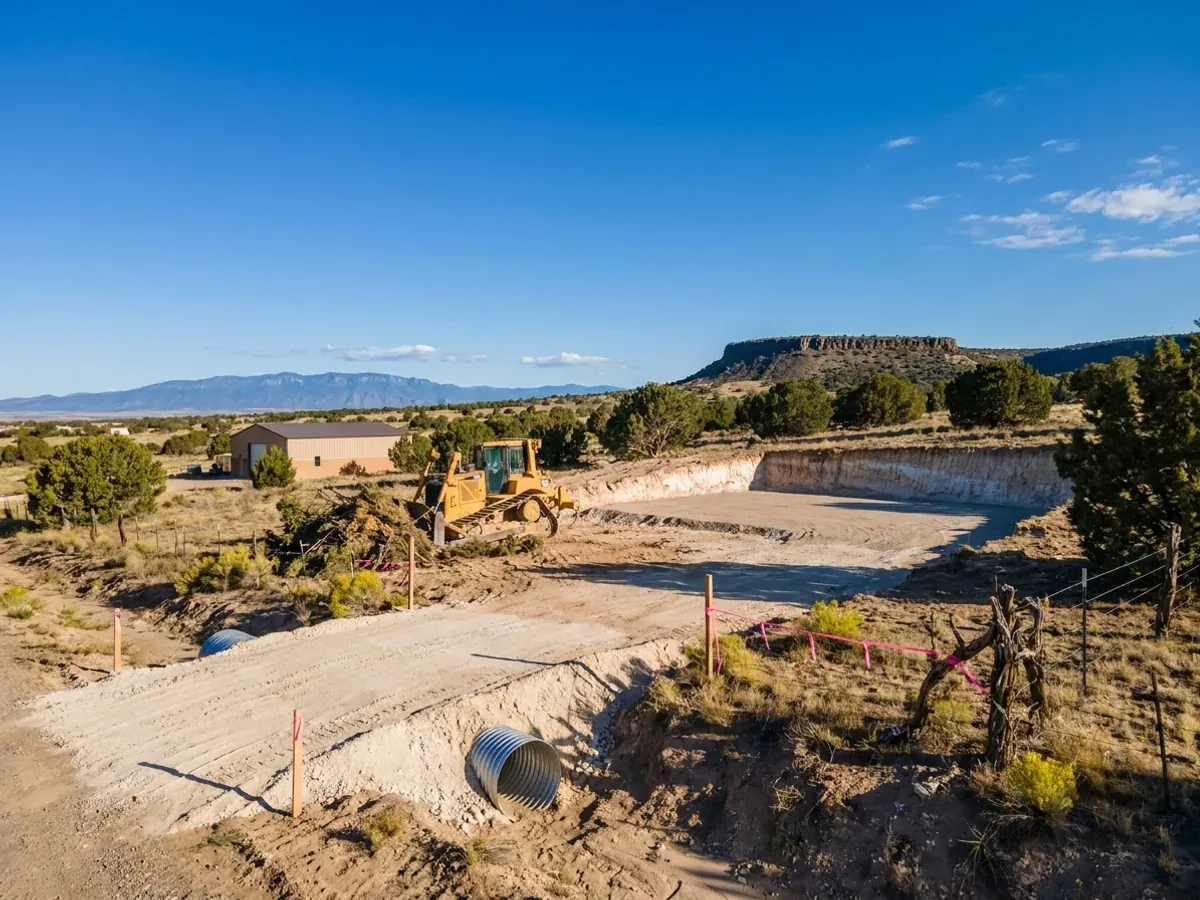
Most of what goes wrong on a barndominium goes wrong below the slab. Site preparation is clearing, cut and fill, a compacted pad, drainage, the drive and any arroyo crossing, and getting water, wastewater and power to the building. On New Mexico land it starts with two questions: where the water comes from, and what the ground does when it gets wet. The New Mexico Bureau of Geology calls collapsible soils common in the state — dry soils that compact when water reaches them — and recommends testing before building. That answer belongs before the pad is set, not after. We draw the site, grading and drainage plan; the dirt work itself is done by a New Mexico-licensed contractor.
Site Preparation: how the work runs
Four stages, in this order. The sequence matters more than it looks: getting the design values, the water and wastewater answers and any permits settled before anything is fabricated is what keeps a New Mexico build from stalling.
Boundary, access, water and authority
Before any dirt moves, four things are settled on paper, and they are the first things we research: where the lines are, how you get onto the parcel legally, where the water supply will come from, and who has authority over the land — a city, a county, or on tribal trust land the tribal government. A licensed land surveyor locates the corners where they are not already clear, and the access permit comes from whoever owns the road. Nothing is scheduled until those answers are in hand.
Soil testing: collapse, swelling and caliche
The New Mexico Bureau of Geology recommends testing undeveloped ground for collapsibility as well as shrink-swell potential, corrosiveness and depth to bedrock. NMSU Extension adds that the USDA soil survey can estimate depth to caliche, a cemented layer that can be soft and thin or a hard, thick bed. The results decide the pad, the footing design and the equipment, and they are worth having before the land is bought.
Pad, drainage and the monsoon
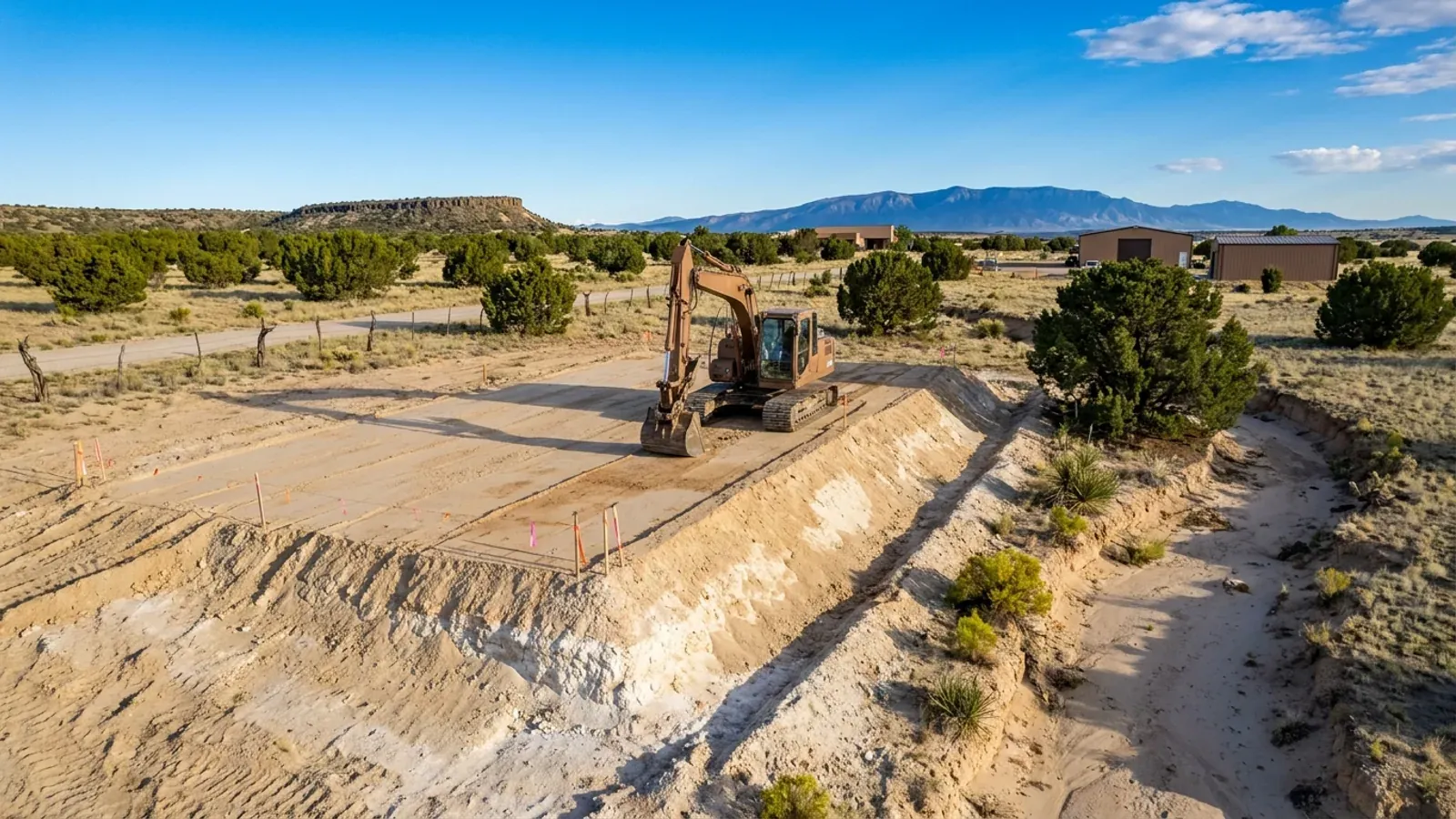
Topsoil and brush are cleared, the pad is cut and filled to design elevation, and fill is compacted in lifts and tested. Where the soil is collapsible, thin layers can be removed and recompacted and thicker ones pre-wetted before building, as the Bureau of Geology describes. Then the drainage: the National Weather Service warns that monsoon storms bring flash flooding, so the pad sits above the natural flow lines and roof water is carried away from the foundation, never left to soak in beside it.
Wastewater, water and power to the pad
Where the lot needs an on-site wastewater system, New Mexico's liquid waste rule says the house may not be built until the Environment Department has issued the system permit, so it is settled first; a conventional system needs at least three-quarters of an acre under the rule's table. A new domestic well is permitted by the Office of the State Engineer, and drilling by a driller licensed in New Mexico is usually a condition of that permit. Power comes last, run to a service location the utility has approved. A New Mexico-licensed contractor does the dirt work to the site plan we draw.
New Mexico's dry ground can be the problem, not the solution
The New Mexico Bureau of Geology describes collapsible soils as loosely packed particles that "compact and collapse after they get wet", commonly tens of feet thick on valley margins. It records damage in housing developments "from Velarde to Las Cruces and from Alamogordo to Socorro", homes condemned, and one El Llano site near Española where a collapse 150 feet across split two foundations. Its advice for new building is plain: test the soil first, and keep water — from roofs, irrigation, leaking lines and wastewater — away from the foundation.
Site Preparation across New Mexico
In New Mexico two things change as you cross the state: who has authority over the parcel, and how high it sits. A city, a county and tribal or federal land each answer the permit and zoning questions differently, and the elevation decides how much snow the roof carries and how deep the footings go. Lower desert parcels trade snow for sun, wind and summer storms; mountain parcels add snow load and, in forested country, wildfire. Water and wastewater are settled for every parcel before anything is drawn.
Barndominium builders across New Mexico.
Every city and county we serve has its own answer on permits, water, wastewater and design values. The service area pages set out what each one publishes.
What actually decides the price
Square footage is the number everyone leads with, and it is rarely the one that moves a barndominium budget. These four do.
-
Water supply
Whether the parcel can join a community or shared water system, or needs its own well, and how far down a driller has to go, is the least predictable line on a rural New Mexico budget. It is also the question to answer before you buy, because a parcel without a workable water supply is not a building site.
-
Soil: collapse, swelling and caliche
A site with firm, stable soil needs little more than clearing and a compacted pad. Collapsible soil can mean removing and recompacting it or pre-wetting it; expansive clay can call for a stiffened slab; hard caliche slows every trench and footing. The soil report is cheap relative to any of those differences.
-
Drive length and arroyo crossings
A long drive on a rural parcel needs a base that will carry a loaded concrete truck, a crossing that survives a monsoon flow where it meets an arroyo, and an access permit from the road authority. Length and the number of drainages crossed move this number more than anything else.
-
Distance to power
How far the service has to run from the nearest line, and whether it goes overhead or underground, can be a significant cost on a set-back building site. Ask the utility for a line-extension estimate early; its policy decides who pays for what.
Site Preparation in New Mexico: common questions
8 questions we get asked most often about building in New Mexico. If yours is not on the list, ask it directly.
What should I check before buying land for a barndominium in New Mexico?
What are collapsible soils?
What is caliche, and does it matter for building?
How do I keep monsoon storms from flooding the site?
How deep do footings go in New Mexico?
Do I need a permit for a well?
What does site preparation involve on a forested parcel?
Do I need a septic permit in New Mexico?
Keep reading
The pages that answer the next question this one raises.
How Long Does It Take?
Where site work sits in the schedule, including water, wastewater and the monsoon.
Read itBarndominium Cost Guide
Site work is the largest wildcard on any rural build. Here is why.
Read itService Areas
Who handles permits, water and wastewater in each New Mexico city and county we serve.
Read itReady to put site preparation against a real plan? Start there and the rest follows.
Tell us about the land
Tell us where the parcel is and what you want on it, and we will come back with who has jurisdiction, what the land needs before it can be built on, and what the plans and the kit have to cover. Starting the survey costs nothing.