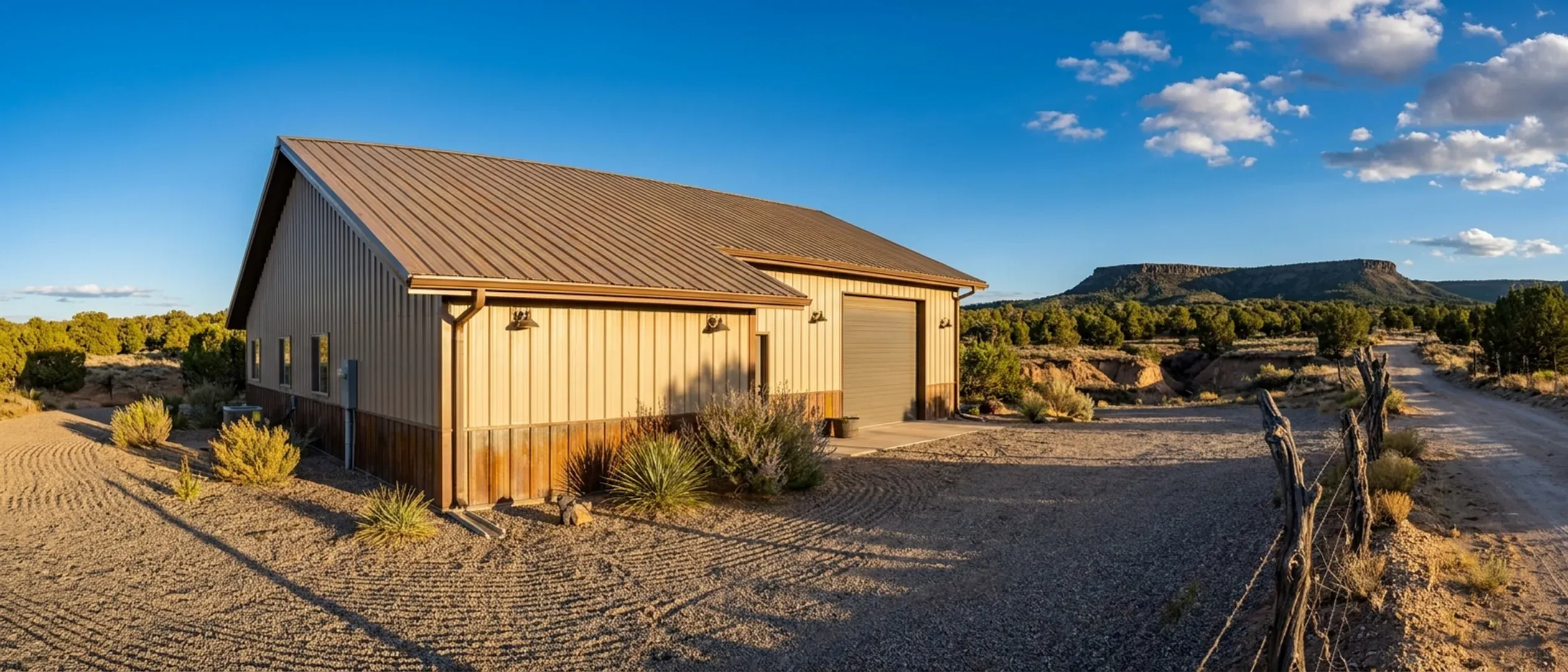
Are Barndominiums Legal in New Mexico? Codes, CID Permits, Licensing, Septic, Wells and Zoning
Nothing in New Mexico law singles out a barndominium. A post-frame or steel-framed house is a one-family dwelling, and it is built to the same statewide code as any other: the 2021 New Mexico Residential Building Code, issued by the Construction Industries Division of the Regulation and Licensing Department as 14.7.3 NMAC. What changes from parcel to parcel is who administers that code, and which other state programmes reach the land. The building permit comes either from CID or from a city or county with its own full-service building department. The septic permit comes from the New Mexico Environment Department. A domestic well is permitted by the Office of the State Engineer. Zoning is local. And the person who builds the house must, with narrow exceptions, hold a contractor's licence from CID, because New Mexico licenses contractors rather than merely registering them. This guide walks through each layer from the statutes and rules themselves, so you can tell which ones reach your land before you buy it or draw a plan.
Figures on this page are cited third-party or government data, not a quote from New Mexico Barndominium Builders.
Bottom Line Up Front
- A barndominium is legal anywhere in New Mexico that a house is legal. The state residential code, 14.7.3 NMAC, adopts the 2021 International Residential Code with New Mexico amendments and contains no separate rule for post-frame or steel homes.
- Building for someone else requires a New Mexico contractor's licence. Under NMSA 1978 § 60-13-3 a contractor includes anyone who offers to undertake construction, by himself or through others, and a construction manager who coordinates the building process; acting as a contractor without a licence is a misdemeanor under § 60-13-52.
- An owner can build his or her own primary residence under a homeowner's permit (14.5.2.18 NMAC), but must do the major portion of the work by dollar value, and a septic system cannot be built on a lot that needs one until the Environment Department has issued its permit (20.7.3.401 NMAC).
Building it yourself: the homeowner's permit
New Mexico lets an owner build his or her own house without becoming a licensed contractor, on conditions set out in 14.5.2.18 NMAC and in the owner-builder exemptions of § 60-13-3. It is the route most kit buyers ask about.
Your primary residence only
A homeowner's permit is issued only to the property owner, with proof of ownership, for the owner's primary residence, occupied or intended to be occupied by the owner. It covers single-family dwellings and appurtenant structures such as private garages, carports and sheds, and does not apply to rental property, other owned property, or any commercial work or property.
You must do the major portion of the work
The owner may do the work alone or with legal employees, or act as the general contractor and subcontract portions to licensed contractors, but the major portion of the work, measured by dollar amount, must be completed by the homeowner. All subcontracted work must go to licensed contractors, who pull their own permits and pass their own inspections.
Not when a licensed contractor runs the job
A homeowner's permit is not valid for a project where a GB-2 or GB-98 licensed contractor is contracted to manage, supervise or act as the general contractor. If a contractor is running the build, the contractor pulls the permits and is responsible for all the work.
Trade permits have their own conditions
Separate homeowner's permits are issued for general building, mechanical-plumbing and electrical work. An electrical homeowner's permit requires plans showing the equipment and panel schedule and a pass on CID's homeowner electrical exam; a plumbing homeowner's permit may require a written exam; a failed exam cannot be retaken for 30 days. No homeowner's permit is issued for HVAC, natural gas or LP gas installations, which must be done by licensed contractors.
What you file
The application, a signed and notarised homeowner's permit responsibility sheet, an acknowledgement of the permit instructions, zoning approval from the local planning and zoning department, a flood plain determination, proof of identity and ownership, and the fees.
Not for building to sell
A homeowner's-permit project may not be placed on the market for sale while under construction; doing so voids the permit and can lead to unlicensed-contracting charges. No more than one homeowner's permit for a single-family dwelling is issued to the same owner in any 12-month period, and under 14.5.3 NMAC the certificate of occupancy for such a house states that it was built under a homeowner permit.
The farm and ranch exemption is narrower than it sounds
Section 60-13-3 also exempts an owner who, personally or with wage-paid help, builds improvements on his own farm or ranch, and says state and local codes shall not require permits or inspections for that construction except electrical wiring connected to an outside power source. How CID applies that to a dwelling is a question to put to CID in writing before relying on it; do not assume a house on ranch land needs no permit.
Septic: the Environment Department's permit comes first
Most rural barndominiums need an on-site liquid waste system. The rule is 20.7.3 NMAC, adopted by the Environmental Improvement Board and administered by the New Mexico Environment Department, which permits on-site systems everywhere in the state except unincorporated Bernalillo County.
Permit before the system, and before the house
No one may install a new on-site liquid waste system without a permit issued by the Department before construction (20.7.3.401 NMAC, subsection A), and no one may construct a residential unit on a lot that requires such a system until the Department has issued the permit (subsection B). Applications go to the Department's field office for the area.
Who may install it
The installer must hold an appropriate CID contractor's licence, except that a qualified homeowner may install permitted septic tanks and conventional trench or bed disposal fields. Every homeowner-installed system is inspected by the Department.
Sized on bedrooms, limited by lot size
Residential design flow is set by bedroom count: 150 gallons a day for one bedroom, 300 for two, 375 for three, 440 for four and 500 for five (20.7.3.201 NMAC). A bedroom is any room designated as a sleeping room on the drawings submitted for the building permit. A conventional system may not be installed on a lot smaller than 0.75 acre, and Table 301.1 in 20.7.3.301 NMAC rises to 0.88 acre at 440 gallons a day and one acre at 500. Smaller lots or higher flows need a system that reduces nitrogen.
Stricter requirements on some land
The Department may impose more stringent requirements where a body of water is vulnerable, for example a water-table aquifer with 100 feet or less of unsaturated zone, an aquifer under fractured bedrock or in karst, or a site near a known nitrate plume. On written request it will issue a letter of determination within 10 working days saying whether stricter requirements may be imposed on a lot, valid for one year.
Public sewer, where it is available
Where a public sewer with capacity runs in a thoroughfare, right-of-way or easement abutting the lot, the home must connect if the local authority requires it, and the on-site system must be abandoned within 30 days of connection.
The one local exception: unincorporated Bernalillo County
The Environment Department states that Bernalillo County is the only county in New Mexico with its own onsite wastewater ordinance, and that it applies only to the unincorporated parts of the county, such as the South Valley. Inside the City of Albuquerque, Los Ranchos de Albuquerque and Tijeras, the Environment Department is the permitting authority.
Water: domestic wells and the State Engineer
Water is the land question in much of New Mexico. On a parcel without a water system, a house depends on a domestic well permitted by the Office of the State Engineer under Section 72-12-1.1 NMSA and 19.27.5 NMAC.
A permit before drilling
The application is on the State Engineer's form, with a $125 filing fee under 19.27.5.8 NMAC for a new domestic well. The conditions the State Engineer may attach under 19.27.5.13 NMAC include construction by a driller licensed in New Mexico and a setback of at least 50 feet from any existing well of other ownership. A well on land owned by someone else, including the state or the federal government, needs the landowner's written consent.
How much water
A domestic well serving one household is limited to 1.0 acre-foot a year, or up to 3.0 where the applicant shows the combined diversion will not impair existing rights. A court or a lawful municipal or county ordinance can impose tighter limits.
Where a new well can be refused
The State Engineer may reject an application where a court has restricted new wells or the use of water, or in an area of water-quality concern where a government entity has prohibited or recommended against new wells.
The permit expires in a year
The permit expires automatically unless the well is completed and the well record filed within one year of issue, and the rule allows no extension; a new permit and fee are then required.
Zoning, land status and private restrictions
The codes say how to build; these decide whether a house can go on the land at all.
Zoning is local
Whether a dwelling is allowed, minimum lot size, setbacks and limits on large accessory buildings are set by the city or county. CID expects planning and zoning approval before it will issue a building permit, and lists a missing zoning approval as the first cause of slow permits; the homeowner's permit rule requires it outright. Ask the planning office for the district rules on your parcel before you buy.
Flood plain
A flood plain determination from the local flood plain department is one of the documents required for a homeowner's permit under 14.5.2.18 NMAC, and building in a mapped flood hazard area brings its own design requirements.
Tribal trust land follows tribal and federal rules
Under 25 CFR 1.4, state and local laws that zone or otherwise regulate the use or development of property, including water rights, do not apply to property held in trust by the United States for a tribe or its members, or subject to a federal restriction on alienation, unless the Secretary of the Interior makes them applicable. On trust land within the Navajo Nation, the Pueblos or the Apache nations, the tribal government and federal agencies, not CID or the county, are the authorities to ask.
Covenants and HOAs
Subdivision covenants and homeowners' association rules are private restrictions that can prohibit metal siding, limit accessory buildings or set minimum sizes, even where zoning and the code allow a barndominium. Read the recorded covenants before you buy.
Wildfire planning
The Forestry Division of the Energy, Minerals and Natural Resources Department publishes an interactive map of New Mexico Communities at Risk and works with counties on Community Wildfire Protection Plans. If your parcel is in a mapped community, ask the county whether any local requirements apply, and expect an insurer to ask as well.
Plans, lenders and insurers
None of these are legal gates on their own, but each can stop a build that the law allows.
Steel-frame and kit barndominiums: expect sealed plans
CID's Building Permit Guide for Residential Construction (2024) says plans and specifications for construction using structural steel members (red iron) and for all prefabricated, premanufactured and component structures must be prepared and sealed by a New Mexico registered architect or structural engineer, and that sealed engineered truss specifications must accompany wood trusses. So where CID issues the permit, expect a steel-frame or kit barndominium to need plans sealed by a New Mexico-licensed engineer; a city or county building department may set its own rule, so ask it. The exception in 14.5.2.10 NMAC, under which plans for a single-family dwelling of not more than two stories need not be prepared by an architect or engineer, fits a conventionally framed house, and even there the building official can require a seal.
Count the whole roof
CID's FAQ tells applicants to combine all covered or roof space when stating square footage on the state application, so the shop bay and covered porches of a barndominium are part of the permitted area.
Keep the permit file
CID's FAQ warns that insurance may be denied if no proof of permitting, inspections or a certificate of occupancy can be provided. Keep the building, trade, septic and well records together; a lender's appraiser and a future buyer will ask for them.
The appraisal is usually the constraint
A construction or permanent loan depends on comparable sales. Where few post-frame or steel homes have sold nearby, the appraiser may lean on conventional houses and adjust. Bring plans and specifications to the lender early.
Seven questions that settle whether your barndominium is legal where you want it
Answer these in order for a specific parcel.
1. Is the land private fee land, tribal trust land or public land?
Trust land follows tribal and federal rules under 25 CFR 1.4; start there if the parcel is within a reservation or Pueblo boundary.
2. Does the zoning allow a dwelling, and a building this size?
The city or county planning office answers this, and its approval is needed before a building permit.
3. Who is the permitting authority?
A city or county full-service building department, or CID. Ask which design values apply and, if it is a local department, whether it requires sealed plans for a steel-frame or kit building, as CID's residential guide does.
4. Will the lot take a septic system?
Check the lot size against 20.7.3.301 NMAC for your bedroom count, and ask the Environment Department for a letter of determination.
5. Where will the water come from?
A water system, or a domestic well permit from the State Engineer, subject to any court or local limits.
6. Who will build it?
A New Mexico-licensed contractor with a GB-2 or GB-98 classification, or you under a homeowner's permit for your own primary residence, doing the major portion of the work yourself.
7. Do covenants allow it?
Read the recorded restrictions for the subdivision, if any.
Reading this because you are weighing a build? The next step is a plan drawn for your program.
What's different about New Mexico
One residential code for the whole state
The 2021 New Mexico Residential Building Code, 14.7.3 NMAC, adopts the 2021 International Residential Code by reference, as amended by the rule, and applies to detached one- and two-family dwellings and their accessory structures that are subject to CID's jurisdiction. It sits alongside the 2021 New Mexico Residential Energy Conservation Code (14.7.6 NMAC) and the New Mexico electrical, mechanical and plumbing codes the rule cross-references. Nothing in the residential code treats a post-frame or steel-framed house differently from a stick-framed one. Two New Mexico amendments are worth knowing: automatic fire sprinklers are not required in one- and two-family dwellings of not more than three stories, and the rule carries a seismic exemption for buildings whose bearing walls are earthen, which does not apply to a post-frame or steel frame.
Who issues the building permit: CID or a local building department
New Mexico's permit rules define the authority having jurisdiction as the state, or a municipality, county or other political subdivision that has a full-service building department employing a full-time certified building official with permitting, inspection and enforcement authority over the general construction, electrical and mechanical-plumbing trades (14.5.1 NMAC). Where no such local department exists, the Construction Industries Division issues the permits and does the inspections. Under 14.5.2 NMAC no building may be built without a permit from the appropriate authority, and separate permits are required for general building, electrical, mechanical and plumbing, and LP gas work. Find out which authority covers your parcel first: it decides where you apply, the review times and the design values you build to.
Design figures belong to the permitting authority
The residential code leaves the climatic and geographic design table of the IRC, which carries values such as ground snow load, wind speed, frost depth and seismic category, for the authority having jurisdiction to fill in; 14.7.3 NMAC only adds that the seismic category may come from the U.S. Geological Survey's design-values software. So there is no single New Mexico snow load or wind speed for a barndominium. The energy code is different: 14.7.6 NMAC sets climate zones by named location, from 3B in Las Cruces, Carlsbad and Roswell to 7B in Red River and Angel Fire, and lets the building official assign a zone for unlisted places from elevation and degree days.
New Mexico licenses contractors, and the definition is broad
Under NMSA 1978 § 60-13-12 no person may act as a contractor without a licence from the Construction Industries Division classified for the work. Section 60-13-3 defines a contractor as any person who undertakes, offers to undertake by bid or other means, or purports to have the capacity to undertake, by himself or through others, contracting, which includes constructing a building or other structure, levelling or clearing land and excavating earth. It also includes a construction manager who coordinates and manages the building process. Acting as a contractor without the required licence is a misdemeanor under § 60-13-52, and an unlicensed contractor cannot sue to collect payment or claim a mechanic's lien under § 60-13-30. For a house, the relevant classifications in 14.6.6 NMAC are GB-2, residential, and GB-98, general building.
Kit supply is not contracting; erecting the kit is
Section 60-13-3(D)(1) excludes from the definition a person who merely furnishes materials or supplies at the site without fabricating them into, or consuming them in, the work of a contractor. The annotation to that section in the official NMSA, summarising Verchinski v. Klein (1987-NMSC-003), notes that ordering, delivering and merely arranging for the installation of materials does not make a supplier a contractor where the supplier is not in control of the installation. The practical line for a barndominium kit is clear: selling and delivering the kit is supply, while erecting it, preparing the site or managing the build is contracting and needs a licensed contractor, or the owner under a homeowner's permit.
What a licence does and does not do for you
Under § 60-13-19 a licensed contractor must show the licence number on all written bids and when applying for a building permit, and building permits carry the general contractor's name, address and licence number under § 60-13-59. Before residential work starts, a contract is signed or money is paid, the contractor must also give the owner a written disclosure, on a CID-approved form, that the licence and the bond or other proof of responsibility required by the Act do not protect the consumer if the contractor defaults (§ 60-13-19(C)). Ask for the licence number, check it with CID, and treat the written contract, the payment schedule and lien releases as your protection.
Pros and cons, honestly
Pros
- New Mexico's residential code has no separate rule for post-frame or steel homes, so no special approval is needed because of the structural system.
- One statewide residential code means the standard is the same whether CID or a local building department issues the permit.
- The residential code does not require fire sprinklers in a one- or two-family dwelling of up to three stories.
- CID's residential permit guide states in advance which building methods need sealed plans, so the requirement can be budgeted before you apply.
- Owners can build their own primary residence under a homeowner's permit.
- Kit supply is outside the contractor definition, so a kit can be bought from a supplier and erected by a licensed contractor or by the owner.
Cons
- Anyone who builds, erects, prepares the site or manages construction for you must hold a CID licence, and the definition reaches those who offer to do it through others.
- Where CID permits, a red-iron steel or kit barndominium is expected to need plans sealed by a New Mexico-licensed architect or structural engineer, per CID's residential permit guide.
- The homeowner's permit requires the owner to do the major portion of the work and excludes HVAC and gas work.
- A lot under 0.75 acre cannot take a conventional septic system, and some land faces stricter requirements.
- Water can decide the project: domestic wells are limited and can be refused in some areas.
- Design values such as snow load and wind speed vary by permitting authority, so a plan drawn for one place may need changes in another.
- Covenants can prohibit a barndominium where the law allows one.
Are barndominiums legal in New Mexico?
Does New Mexico have a statewide building code for houses?
Do I need a building permit for a barndominium in rural New Mexico?
Do I need a licensed contractor to build a barndominium in New Mexico?
Can I buy a barndominium kit and put it up myself?
Who approves the septic system?
Can I drill a well for my barndominium?
What snow load and wind speed apply to my barndominium?
Does a contractor's licence or bond protect me if the builder defaults?
Can I build a barndominium on tribal land?
Questions answered? Tell us what you want to build and we will put real numbers against it.
Sources
- 14.7.3 NMAC — 2021 New Mexico Residential Building Code
- 14.7.6 NMAC — 2021 New Mexico Residential Energy Conservation Code
- 14.5.1 NMAC — General provisions (authority having jurisdiction)
- 14.5.2 NMAC — Permits (submittal documents, homeowner's permit)
- Construction Industries Division — Building Permit Guide for Residential Construction (2024)
- New Mexico Environment Department — Liquid Waste Regulations (Bernalillo County ordinance)
- 14.5.3 NMAC — Inspections
- 14.6.6 NMAC — Contractor licence classifications (GB-2, GB-98)
- NMSA 1978 Chapter 60 — Construction Industries Licensing Act (§§ 60-13-3, 60-13-12, 60-13-19, 60-13-30, 60-13-52, 60-13-59)
- 20.7.3 NMAC — Liquid waste disposal and treatment
- 19.27.5 NMAC — Domestic well permits (State Engineer)
- Construction Industries Division — Frequently Asked Questions
- 25 CFR 1.4 — State and local regulation of the use of Indian property
- EMNRD Forestry Division — Community Wildfire Protection Plans
Keep reading
The pages that answer the next question this one raises.
Permitting help
Working out which authority permits your parcel and what each application needs.
Read itBarndominium kits
Kit supply, and how a kit is erected by a licensed contractor or an owner-builder.
Read itCustom plans
Plans drawn to your parcel, bedroom count and climate zone.
Read itBarndominium build timeline
Septic before the house, well permits, permit clocks and the monsoon.
Read itBarndominium financing
Construction loans, appraisal and what lenders ask for.
Read itTell us about your land
Start the survey with your parcel's location and we will work out which of these rules apply.
Read itWant a real number instead of a range?
Start the survey and tell us about your land and what you want to build. Include the county and parcel ID if you have them, because in New Mexico the jurisdiction, the water supply, the well and the septic answers change the budget more than the building does. The survey costs nothing.