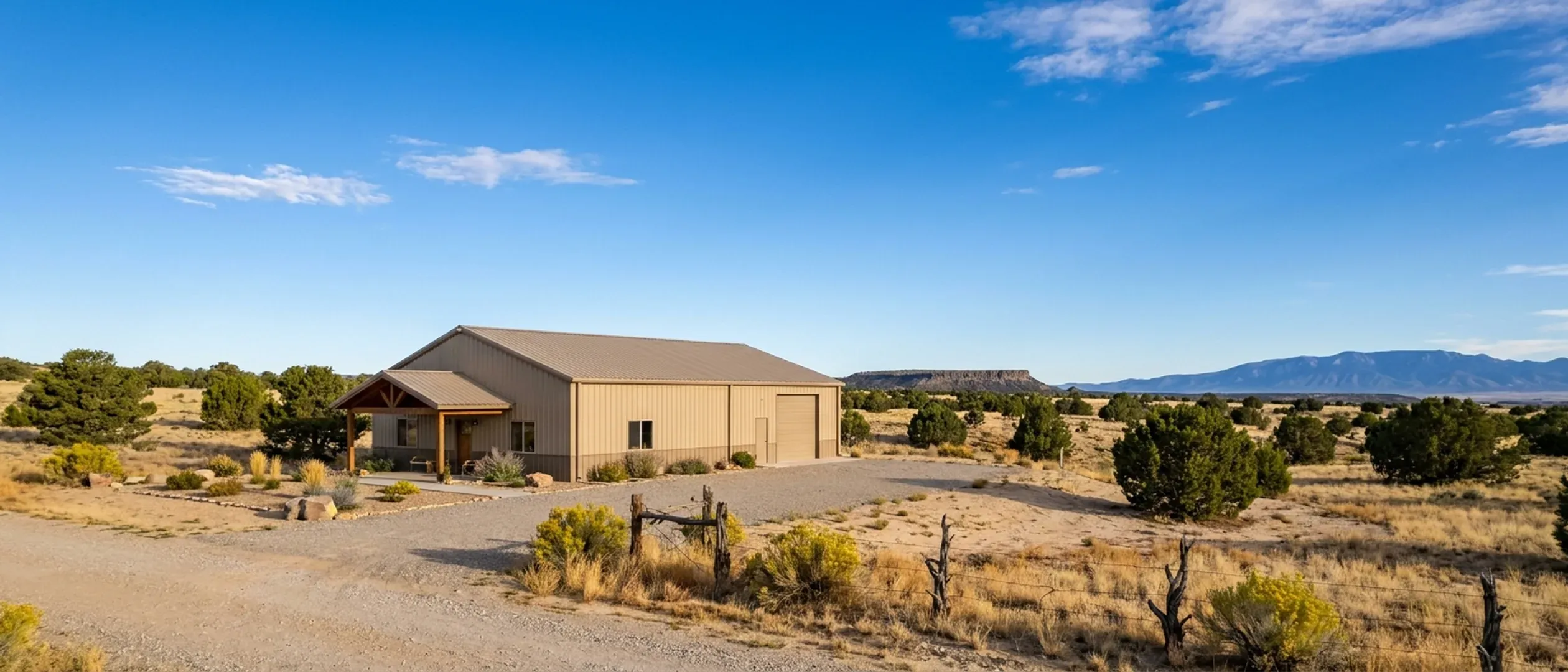
Barndominium vs. House Cost in New Mexico: Which Is Cheaper to Build?
The claim that a barndominium is always cheaper than a house does not survive a look at where construction money goes. NAHB's 2024 builder survey splits a new home's construction cost into stages, and a steel or post-frame shell changes only some of them. This guide walks through those stages, what the Census Bureau's figures for the West region say about custom homes, and the New Mexico factors that apply to either kind of building. Every figure is a cited third-party number, not our pricing.
Figures on this page are cited third-party or government data, not a quote from New Mexico Barndominium Builders.
Bottom Line Up Front
- A barndominium changes the shell: framing (16.6% of construction cost in NAHB's 2024 survey) and exterior finishes (13.4%). Interior finishes (24.1%) and mechanical rough-ins (19.2%) cost the same in either building.
- Steel-framed homes are rare in the Census data: 1% of contractor-built homes completed in the West in 2025 had steel framing and 99% wood. Rarity is what makes appraisal comparisons harder.
- In New Mexico the land, the well, the septic system and the soil work cost the same whichever building sits on them, and on a rural parcel they can decide the budget.
What actually moves the number
Clear spans and fewer walls
A post-frame or steel building carries its roof on a few large members, so the interior can be open with few bearing walls. Fewer interior walls means less framing, drywall and trim, and those savings are real when the plan is genuinely open.
Finishes decide the total
NAHB's 2024 survey puts interior finishes at 24.1% of construction cost, the largest single stage. A barndominium with the same kitchen, baths and flooring as a conventional house spends the same on this stage.
Shop space is the real bargain
A large shop or garage under the same roof is where a barndominium most clearly beats building a house plus a separate outbuilding. Unfinished shop space needs a slab, a shell and power, not living-space finishes.
Appraisal can offset savings
If a lender's appraiser cannot find comparable sales, the appraised value may come in below cost, and the buyer covers the gap in cash. Fannie Mae's Selling Guide treats unique housing case by case.
Where a barndominium can cost less
The savings sit in the structure and the skin. NAHB's 2024 survey shows how large those stages are.
Fewer, larger structural members
NAHB puts framing, including the roof, at 11.6% of construction cost and the whole framing stage at 16.6%. Posts or steel frames at wide spacing replace many studs and rafters, which can trim that stage.
Metal roofing and wall panels
Exterior finishes are 13.4% of construction cost in NAHB's survey. Metal panels install quickly over a large area, and on a simple rectangular building they can cost less than stucco or siding on a complex conventional elevation.
Open plans need fewer interior walls
Every interior wall carries framing, drywall, paint and trim. A plan that uses the building's clear span for open living space saves on all four.
Shop and living under one roof
Building one structure instead of a house plus a detached shop saves a second foundation perimeter, a second roof and a second set of exterior walls.
Where it costs the same
Most of a home's cost has nothing to do with what holds the roof up.
Kitchens, baths and floors
Interior finishes are 24.1% of NAHB's construction cost. Cabinets, counters, tile and fixtures cost the same in any building.
Plumbing, wiring and HVAC
Mechanical rough-ins are 19.2% of construction cost. A tall open barndominium can need more heating and cooling capacity than a conventional house of the same floor area, so this stage can go up rather than down.
Foundation and ground conditions
NAHB puts foundations at 10.5% of construction cost. The New Mexico Bureau of Geology describes collapsible soils as common in the state; a soil report and a foundation designed for what it finds cost the same under either building.
Land, well, septic and access
The State Engineer's $125 domestic well filing fee (19.27.5.8 NMAC), the Environment Department septic permit (from $225 under 20.7.11.8 NMAC), the drilling, the drain field and the driveway are identical whatever gets built.
What the West-region numbers say about custom homes
The Census Bureau publishes costs by region; New Mexico sits in the West. These are figures for all homes, not barndominiums.
Custom homes on your own land
The Census 2025 median contract price per square foot for contractor-built homes on the owner's land in the West was $176.87, and the average $213.85, excluding the lot.
Homes builders sell
Census figures for new homes sold by builders in the West were higher: a 2025 median of $212.50 and an average of $224.31 per square foot of floor area, lot excluded.
Size is part of the difference
The Census median West contractor-built home completed in 2025 had 2,354 square feet. A barndominium's living area plus a large shop can make square-foot comparisons misleading unless shop space is priced separately.
What this means for a comparison
Compare like with like: the same living area, the same finish level, the same site. When you do, the difference between a barndominium and a conventional house is the shell and the shop, not the whole budget.
Resale and appraisal
A lower build cost only helps if a lender and a future buyer value the finished home.
Lenders treat unusual homes case by case
Fannie Mae's Selling Guide says loans on unique or nontraditional housing are eligible provided the appraiser has adequate information to develop a reliable opinion of market value, and that both the appraiser and the underwriter decide this case by case.
Comparable sales do not need to match exactly
The same guide says it is not necessary for comparable sales to be of the same design, although accuracy improves with the most similar sales. The appraiser can use older sales or competing neighbourhoods to show market acceptance.
A big shop can change how the property is read
Fannie Mae treats large barns, silos and farm-animal facilities as significant outbuildings that may indicate an agricultural property, and the lender must decide whether the property is residential in nature.
Where a conventional house is the better value
On a small lot in a subdivision with design standards, or where there are no barndominium sales to compare against, a conventional house can be the cheaper home to finance and resell, even if the barndominium costs less to build.
Reading this because you are weighing a build? The next step is a plan drawn for your program.
What's different about New Mexico
The same residential code applies to both
14.7.3 NMAC adopts the 2021 International Residential Code, as amended, for one- and two-family dwellings under the Construction Industries Division's jurisdiction. A barndominium home is a dwelling like any other, so it meets the same structural, egress and energy rules as a conventional house. One difference costs money: where the Construction Industries Division issues the permit, its residential permit guide calls for plans sealed by a New Mexico registered architect or structural engineer for red-iron steel and prefabricated structures; a local building department may set its own rule.
Energy code costs rise with elevation, for both
14.7.6 NMAC assigns climate zones by location and elevation, from 3B in Las Cruces and Carlsbad to 5B in Santa Fe and Farmington and 7B in Angel Fire and Taos Ski Valley. Insulating a metal-clad building to the zone's requirement is part of the barndominium's budget, not an extra.
Stucco is the local norm to compare against
The Census Bureau found stucco on 33% of contractor-built homes completed in the West in 2025, and fiber cement on 37%. A metal-sided barndominium looks different from that stock, which matters most in neighbourhoods with design standards and at appraisal.
A storage building is not a home
14.6.7.15(B) NMAC says a storage shed or similar structure offered for sale may not be advertised as safe for human habitation unless converted under the rule. A barndominium home is designed, permitted and inspected as a dwelling from the start, which is part of why it costs more than a shop building.
Pros and cons, honestly
Pros
- Open clear-span interiors with few bearing walls
- Shop, garage or equipment space under the same roof as the home
- Metal roofing and wall panels that install quickly over large areas
- One structure instead of a house plus a separate outbuilding
Cons
- Interior finishes and mechanical systems cost the same as in any house
- Few comparable sales can make appraisal and financing harder
- Insulating a metal-clad building to New Mexico's energy code is a real cost at higher elevations
- Design standards in some neighbourhoods may not suit a metal-sided building
Is a barndominium cheaper to build than a house in New Mexico?
How much does a custom home cost per square foot in New Mexico?
Are steel-framed houses common in New Mexico?
Will a barndominium appraise for what it cost to build?
Does a barndominium have to meet the same code as a house?
Is a barndominium cheaper to insure or heat?
Where does a barndominium save the most money?
Questions answered? Tell us what you want to build and we will put real numbers against it.
Sources
- NAHB — Cost of Constructing a Home 2024 — Table 1: construction cost stages as a share of $428,215
- U.S. Census Bureau — Contract Price per Square Foot of New Contractor-Built Single-Family Houses Started — West 2025: median $176.87, average $213.85
- U.S. Census Bureau — Price per Square Foot of Floor Area, New Single-Family Houses Sold — West 2025: median $212.50, average $224.31
- U.S. Census Bureau — Square Feet of Floor Area in New Single-Family Houses Completed
- U.S. Census Bureau — Type of Framing in New Single-Family Houses Completed — West contractor-built 2025: 99% wood, 1% steel
- U.S. Census Bureau — Primary Type of Exterior Wall Material of New Single-Family Houses Completed — West contractor-built 2025: 33% stucco, 37% fiber cement
- Fannie Mae Selling Guide B4-1.3-05, Improvements Section of the Appraisal Report
- 14.7.3 NMAC — 2021 New Mexico Residential Building Code
- 14.7.6 NMAC — 2021 New Mexico Residential Energy Conservation Code
- 14.6.7 NMAC — Manufactured and modular buildings, storage sheds — 14.6.7.15(B)
- New Mexico Bureau of Geology and Mineral Resources — Geologic Hazards: Collapsible Soils
- 19.27.5 NMAC — Domestic Water Wells
- 20.7.11 NMAC — Liquid Waste Fees
- New Mexico RLD, Construction Industries Division — Building Permit Guide for Residential Construction (PDF, Oct 2024)
Keep reading
The pages that answer the next question this one raises.
Barndominium cost in New Mexico
The full set of published figures: Census West rates, NAHB stages, land values and state fees.
Read itFinancing a barndominium in New Mexico
Construction-to-permanent loans, USDA Rural Development, and how the appraisal works.
Read itBarndominium pros and cons
The trade-offs beyond cost, from resale to design standards.
Read itPost-frame homes
Plans and kits for post-frame barndominiums, erected by New Mexico-licensed contractors.
Read itWant a real number instead of a range?
Start the survey and tell us about your land and what you want to build. Include the county and parcel ID if you have them, because in New Mexico the jurisdiction, the water supply, the well and the septic answers change the budget more than the building does. The survey costs nothing.